-
Responsible Management
Responsible Management
Explore this section to find information and resources designed to support managers and regulators

-
Preparing for a trip
Preparing for a Trip
Explore this section to find information and resources useful to anyone interested in learning more about responsible whale watching throughout the world
-
Industry support
Industry Support
Explore this section to find information and resources useful to whale watching tour operators and guides or other industry professionals
-
Species information
Species Information
Click on one of the icons to the right to reveal a full description of the species with photos and labeled illustrations useful for species identification, as well as information on biology, ecology and conservation status of each species. Click here to find downloadable PDF fact sheets for each of the species featured on this site.


History and context
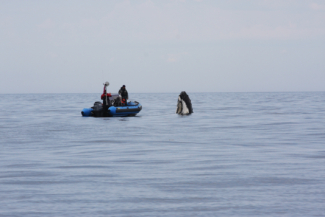
The Mingan Island Cetacean Study (MICS) was founded in 1979 and in 2018 it will be entering its 40th field season in the Gulf of St. Lawrence. The project focuses on baleen whale species, such as blue and fin whales and uses photo-identification, satellite tagging, genetic sampling and other methods to estimate population numbers and survival rates and to determine temporal and spatial distribution and habitat use1-5. The unique long-term data sets generated by the project are allowing the team to monitor population parameters over time and detect important trends1,2. The project has also documented a worrying shift in the arrival times of whales to this important feeding ground, an indication that climate change is affecting whale migrations and their prey3. This important information is published in scientific journals and shared with other bodies responsible for conservation and management of the whales.
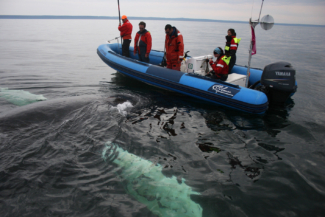
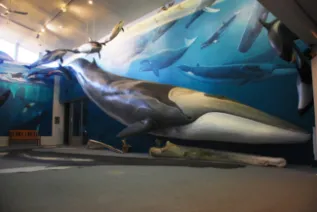
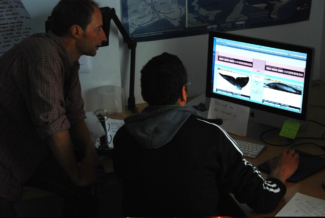
From its inception almost 40 years ago, the project has also included an outreach component which was intended to educate the general public and thus contribute to whale conservation and protection. The project runs museum and gift shop in Longue-pointe-de-Mingan, which hosts roughly 2000 visitors per year, and a whale adoption programme that allows individuals to adopt a whale and receive photos, information, and updates about the chosen whale. One of its most unique outreach programmes revolves around week-long or 2-week long residential research sessions that are open to members of the public. These Whale Research Adventures offer participants the opportunity to become "research apprentices" and join the research team and learn about different techniques employed by biologists who study cetaceans. Through these programmes tourists gain extensive knowledge of cetaceans and research techniques, and at the same time help to fund the project’s work. The project makes it clear that a third of each participant’s fees contribute to the running of the research station and its conservation projects.
Two to three programmes are offered each year accommodating a total of 25-50 participants in varying locations. The main programme is centered at the research station’s headquarters in the Mingan Islands region, while another one is mobile from one year to the next, following the distribution of blue whales during the late summer. Participants are well aware of the conditions of the experience: 6-10 days on small boats (weather permitting), mixed with days on land processing collected data, and matching photographs of whales to the existing catalogue, and other research related tasks.


Regulatory and management measures
The station’s research is conducted under permits from the relevant government authorities, and as such not all of the usual commercial whale watching regulations apply to the team’s work. The research station has made important contributions to conservation management measures to be implemented by government authorities. This included the assessment required to recognize blue whales as an endangered species under Canadaian law in 20026, and involvement in the government-appointed recovery team. In 2012 the project used data from photo-identification surveys yielding over 13,000 blue whale sightings to identify the distribution and densities of blue whales in the northwestern section of the Gulf of St. Lawrence in order to provide additional information for designating blue whale critical habitat as required under the Canadian Species at Risk Act7.
Almost all of the many peer-reviewed published papers produced by the station have included use of data collected with participation from the whale adventure sessions. These continue to contribute to local, national and international conservation and management plans for blue, fin, minke and humpback whales.
The Project also collaborates with local commercial whale watching tour operators in a mutually beneficial photo-identification project. MICS provides the commercial operator with a photo-identification “rap sheet” or catalogue, which allows them to identify some of the most well-known individual humpback whales in their specific area of operation and share information about the whales’ histories with their tourists. This enriches the tourists’ experience, and allows them to feel a greater sense of connection to the whales. In turn, the commercial operator shares photographs that are taken during their tours with MICS, allowing the research project to construct more complete sighting histories for individual whales.
Lessons learned:
This unique residential research participation model for whale watching has numerous benefits to both the participants and the research project. At the same time, there are challenges that need to be taken into consideration before undertaking such a model:
Advantages of involving residential participants in research:
- One third of participation fees help to fund the station’s ongoing research, while the remaining two thirds cover costs of the participants’ accommodation and activities. This has been a helpful and consistent source of funding to complement other grants and funding sources for the conservation based research that in turn has contributed to conservation management measures.
- Participants, while initially inexperienced, provide concrete and valuable support to research and data collection: They provide extra eyes on the boat to help spot whales, help completing data forms on the vessel, and assistance with data processing and photo matching at the end of each day spent on the water. Sometimes their “fresh” eyes offer another valued perspective.
- Participants gain insight into the day-today life of a whale researcher – experiencing the amazing highs of whale encounters, as well as the behind-the-scenes work that goes into preparing for and processing the results of each day on the water.
Challenges
- It is a constant challenge to keep the research station and projects running and running well. Tourism funds only a portion of costs, with some additional income from the museum and boutique. Like all other research projects, it is a struggle to find funding through private sector and/or grants from one year to the next to ensure the continuity of the programme.
- It can also be a challenge to ensure that participants have realistic expectations and are able to cope with the rigours of fieldwork. Through experience, the MICS team has learned how to avoid mismatched expectations by putting a lot of effort into good preparation. Applicants to the programme receive extensive information packs describing what fieldwork and research will entail, and require medical certificates of fitness before arrival. Through this, the programme can ensure that tasks for participation are assigned to best suit each participants’ fitness and interests.
For more information about the Mingan Island Cetacean Study please consult: https://www.rorqual.com/englis...