-
Responsible Management
Responsible Management
Explore this section to find information and resources designed to support managers and regulators

-
Preparing for a trip
Preparing for a Trip
Explore this section to find information and resources useful to anyone interested in learning more about responsible whale watching throughout the world
-
Industry support
Industry Support
Explore this section to find information and resources useful to whale watching tour operators and guides or other industry professionals
-
Species information
Species Information
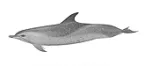
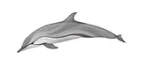
Click on one of the icons to the right to reveal a full description of the species with photos and labeled illustrations useful for species identification, as well as information on biology, ecology and conservation status of each species. Click here to find downloadable PDF fact sheets for each of the species featured on this site.


History and context
The Netherlands is not known as a whale watching hotspot. With no formally developed commercial whale watching industry, much of the Dutch public is unaware that there are any whales or dolphins off their coastlines. And yet, harbor porpoises are common along many parts of the coast, and other species, such as bottlenose dolphins, and increasingly humpback whales are also seen from time to time1-5. In 2007 a group of dedicated researchers and members of the public formed the Dutch NGO ‘Stichting Rugvin’ (The Dorsal Fin Foundation). The group’s main objectives were to contribute to the understanding of whale and dolphin distribution and conservation needs along the coast of the Netherlands and to raise awareness of these issues among the Dutch public. A fairly small group, with limited means, the group relies on a network of roughly 30 volunteers to conduct much of its work. To address their first objective, the NGO has set up three long-term studies: the long term and continuous collection of data through the placement of volunteer observers on the Stena Line ferry crossing between Hoek van Holland and Harwich; the coordination of a large annual volunteer effort to count and photograph harbour porpoises in the Oosterschelde region of Zeeland; and an ongoing photo-identification project to identify individual harbour porpoises off the coast of Zeeland and monitor them over time. Furthermore, between 2009 and 2014 the group conducted acoustic research using underwater hydrophones to monitor harbor porpoise presence in the Oosterschelde. Through this work the NGO established that coastal waters off the town of Zierikzee host a resident group of 30-40 harbour porpoises that are present year-round, and often visible from the town’s harbor jetty.
The NGO’s founder, Frank Zanderink, began to think about ways use this newly acquired knowledge to allow members of the public to experience the same thrill and appreciation that the volunteer research team did every time they observed a porpoise or listened to their vocalizations. He hit upon a unique idea: an onshore listening station where visitors could hear the vocalizations of harbor porpoises in real time as they looked out to sea in this harbor porpoise hotspot.
Turning a concept into reality
Turning this dream into a reality was not easy. First and foremost, funding was required. Luckily, WWF Netherlands, who had supported Stichting Rugvin’s earlier work was captivated by the concept and agreed to fund the effort. The Oosterschelde National Park, the national ‘Nature Monuments Foundation (Natuurmonumenten) and the local municipality (Gemeente Schouwen-Duiveland) also agreed to support the project.
Next, Frank had to find a partner that could design the hardware required to record the sounds offshore, and transmit them to a station onshore. He started with an extensive internet and literature search, hoping that someone would have created a similar exhibit somewhere in the world, but could not find a working model to use as an example. He consulted technical organisations and universities in the Netherlands, USA, and the United Kingdom, but those who appeared to have the necessary technical expertise and experience were either too expensive, or not available to invest the necessary time and resources for the project. Finally, Frank found a partner based in the UK who was willing, and able to design and build the hardware within budget, and work could commence in earnest.
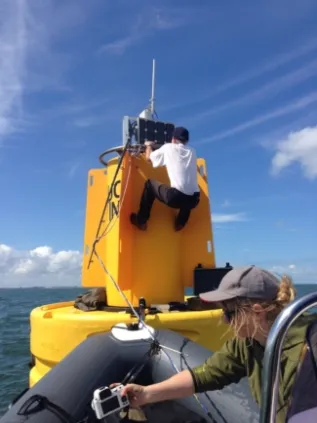
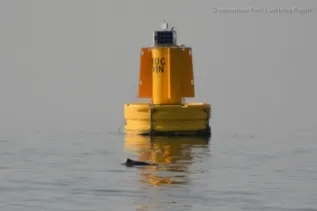
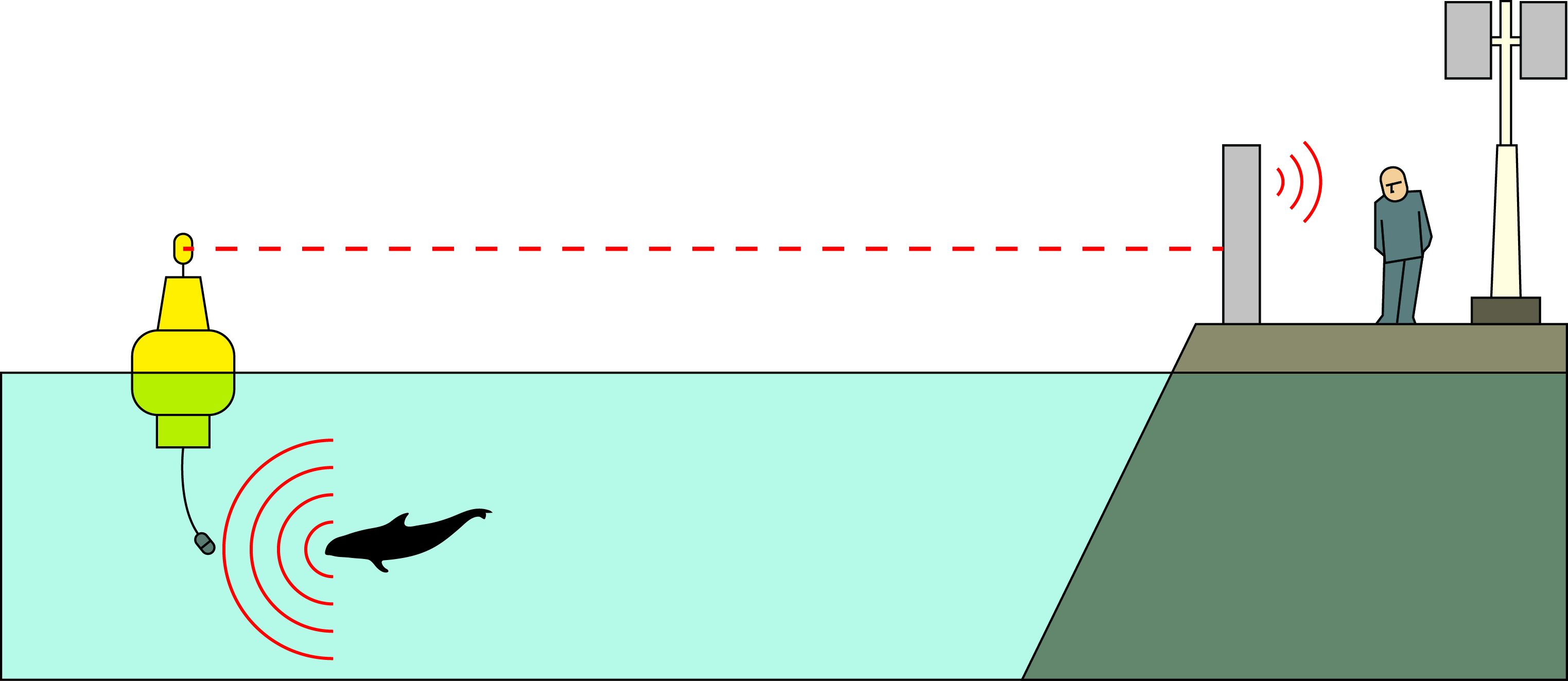
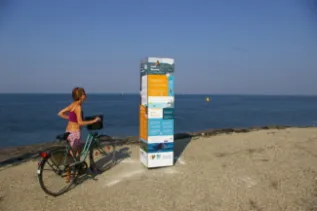
The end product is a hydrophone that hangs underneath a sturdy buoy roughly 350m offshore from the Jetty at Zierikzee. The hydrophone picks up vocalizations and echolocation clicks from harbor porpoises within a few hundred metres and transmits them via radio signals to a receiver housed in a four-sided pillar covered with wealth of information about harbor porpoises. The pillar also houses speakers that play the sounds being picked up by the hydrophone in real time when a visitor presses a button. If there are no harbour porpoises present when a visitor presses the button, they can use their smart phone to scan a QR code that will take them to a site where they can listen to examples of harbor porpoise vocalisations.
While the speakers only play when a visitor activates them, a weather-proofed hard drive converts the radio signals to digital data that are continually recorded 24 hours per day, 7 days a week. Stichting Rugvin researchers (usually students) visit the site at least once a month to change out the USB drive onto which the data are recorded so that they can be analyzed and provide insight into the harbour porpoises’ occupancy patterns in relation to seasons of the year, times of day and tidal states.
The Studio began to operate in October 2016 with a formal launch in May 2017 to coincide with the start of the summer tourist season. In September 2017 a counter was installed on the speaker button, revealing that the studio was attracting an average of 30 visitors per day in a month that was unseasonably cold and wet in Holland. This number must have been higher in the peak summer months before the counter was installed.
Lessons learned
Like any project worth undertaking, the Studio Bruinvis project has had its ups and downs and required perseverance and determination. However, it is a unique model that can serve as an inspiration for others who wish to promote no-impact responsible shore-based whale and dolphin watching in areas with a reliable presence of marine mammals. The strengths and challenges associated with the project below may help others to emulate this inspiring model.
Strengths:
- The listening station is located in a prime location where harbour porpoises are often present. This makes the experience rewarding for tourists.
- The station is located in an attractive area, popular with Dutch tourists and day-trippers. It is accessible by a network of cycle paths (it is Holland, after all!), and surrounded by park benches and areas where visitors can relax and look out to sea. There are also restaurants and snack shops near-by in the city.
- The project (along with all the other research leading up to the design and installation of the studio) has raised local awareness of the resident harbour porpoise population. The National Park now features harbour porpoises in its marketing materials as one of the unique species of wildlife protected by the park, and one local tour operator now includes a focus on harbour porpoises in the daily boat trips it offers during the summer tourism season.
Challenges:
- Like all other projects that rely on technology, Studio Bruinvis has experienced some glitches and malfunctions that have rendered the listening station inactive for periods of days or weeks.
- Sadly, the system has also been subject to vandalism. During the long dark winter nights, there is not much passing traffic or any formal surveillance mechanisms around the listening station, and youths damaged the station’s speaker button with a cigarette lighter in October 2017.
- Because this project was the first of its kind, the technology for it had to be imported from outside the Netherlands. This has meant that replacement parts and the technician to effect repairs also have to be brought over from the UK. Stichting Rugvin tries to maximise on the efficiency of each visit by bundling as many repairs and upgrades to the system as possible into each single visit.
For more information about shore based dolphin watching with a twist in the Netherlands, contact:
Frank Zanderink : rugvinfoundation@gmail.com or visit http://rugvin.nl/english/